Sport-specific
Training Principles for Rowing and Kayaking
rowing · all levels · endurance, aerobic power, upper body strength
Updated
How this document is used
This is one of the 44 documents the phase.fitness generator reads before writing a phase. It receives the principles below as context, and the numbers in it become the bands a generated program has to respect. The references at the end are stripped from the prompt — the model is not allowed to cite studies — and kept here, for you to check.
Rowing and kayaking are full-body endurance sports with a dominant upper-body demand. Both require the integration of cardiovascular capacity, upper-body muscular endurance, and technical efficiency over sustained durations. This document covers evidence-based training principles applicable to both sports.
Physical Demands
Primary Demands
- Aerobic Power (VO2max): Elite rowers and kayakers rank among the highest VO2max values of any sport (75–85 mL/kg/min in elite males). Aerobic capacity is the primary determinant of performance in events lasting 2–30 minutes.
- Lactate Threshold: The ability to sustain high-percentage of VO2max determines race-pace endurance. Training below LT2 (Zone 2) dominates volume in well-designed programs.
- Muscular Endurance: Both sports demand repeated explosive force application (per stroke), sustained over many hundreds or thousands of strokes. The back, shoulders, core, and legs (rowing) must produce power without fatigue-induced breakdown.
- Stroke Efficiency: Economy — the power output per unit oxygen consumed — separates technical athletes from merely fit ones.
Secondary Demands
- Anaerobic Capacity: Critical for sprint efforts (final 250–500m of a 2K row; sprint starts in kayak racing).
- Core Stability: Transmits power from the legs (rowing) or torso rotation (kayaking) to the paddle. A weak core leaks power and increases injury risk.
- Grip and Forearm Endurance: Especially in kayaking, sustained grip over hours can become a limiting factor.
Training Intensity Distribution
Research on elite rowers consistently shows a polarized distribution: approximately 75–80% of training at low intensity (Zone 1–2, below LT1) and 15–20% at high intensity (Zone 4–5, above LT2). Very little time is spent at moderate/threshold intensities (Zone 3) during base and build phases.
This distribution applies equally to well-trained kayakers (Larsson & Forsberg, 2010).
Practical Intensity Distribution for Program Design
| Phase | Zone 1–2 | Zone 3 | Zone 4–5 |
|---|---|---|---|
| Base | 85% | 5% | 10% |
| Build | 75% | 10% | 15% |
| Peak | 70% | 5% | 25% |
| Taper | 85% | 0% | 15% |
Key Training Sessions
Rowing
- Steady State (Zone 2): 20–60 min continuous at 18–22 spm. The backbone of rowing training. Use HR to confirm Zone 2.
- Threshold Intervals: 3–6 × 6–8 min at LT2 (Zone 3 boundary), 2 min easy between. Builds sustainable power.
- VO2max Intervals: 5–8 × 2–3 min at Zone 4–5, 3 min recovery. Elevates aerobic ceiling.
- Power Sprints: 6–10 × 250–500m at race pace or faster, full recovery. Develops anaerobic capacity and stroke power.
- Pyramid Rows: Distance pyramids (500m–1000m–1500m–1000m–500m) with 2 min recovery. Combines speed and endurance.
Kayaking
- Aerobic Paddle: 45–90 min continuous at Zone 2. Develops fat oxidation and stroke efficiency.
- Tempo Paddle: 2–3 × 8–12 min at Zone 3, 3 min easy. Builds comfortably-hard race pace.
- Sprint Intervals: 8–12 × 30 s maximum effort, 90 s recovery. Develops anaerobic power and sprint cadence.
- Technical Drills: Focus on catch depth, torso rotation, and blade exit. Slow, intentional strokes.
- On-Water Distance: Long paddles >60 min to simulate touring or race demands.
Technique Priorities
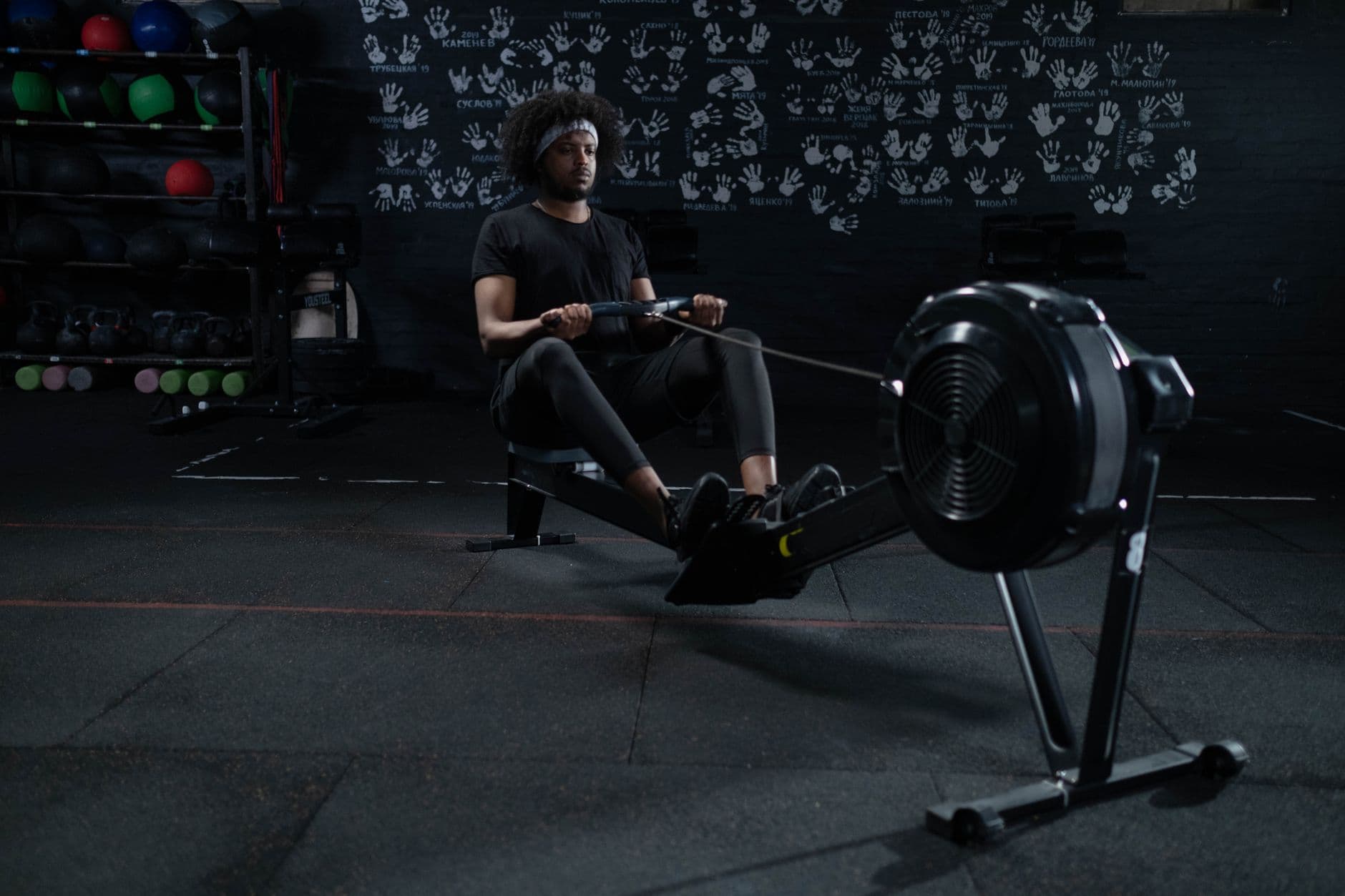
Rowing (Ergometer)
- Drive sequence: legs → back swing → arms (this order is critical)
- Catch: arms extended, blade fully buried before the drive begins
- Finish: handle to lower ribs, shoulders slightly behind hips
- Recovery: arms → body → slide (the reverse sequence)
- Ratio: spend 1/3 of the stroke on the drive, 2/3 on recovery
Kayaking
- Torso rotation: 70–80% of paddle power comes from trunk rotation, not arms
- Catch: blade enters water near the feet, fully submerged before pulling
- Exit: blade exits at the hip — pulling past this wastes energy
- Blade angle: perpendicular to the water surface at catch for maximum efficiency
- High elbow: top arm drives forward and down, not out to the side
Periodization Guidelines
- Base (4–8 weeks): High volume, low intensity. Build aerobic engine. Technique focus.
- Build (4–8 weeks): Add threshold and VO2max sessions. Reduce volume 10–15%.
- Peak (2–4 weeks): Race-specific intensities. Race pace work. Volume drops further.
- Taper (1–2 weeks): 30–50% volume reduction. Maintain intensity. Frequency can drop one session.
Common Errors in Program Design
- Too much Zone 3: Moderate intensity induces fatigue without the training stimulus of Zone 2 (volume) or Zone 4+ (VO2max). Keep it polarized.
- Neglecting recovery rows: After hard sessions, a 20-min easy row accelerates recovery more than complete rest.
- No strength work: Upper body pulling strength (lat pull, seated row) directly improves rowing power. Include 2 strength sessions/week in base/build.
- Ignoring technique under fatigue: Technical breakdown late in training sets ingrained bad habits. Reduce duration when form deteriorates.
References
- Verified against the published record, with DOIs so any number here can be
- checked rather than trusted. This document previously carried no sources at all.
- **Rønnestad, B. R., & Mujika, I. (2014).** Optimizing strength training for
- running and cycling endurance performance: A review. *Scandinavian Journal of
- Medicine & Science in Sports*, 24(4), 603-612.
- DOI: [10.1111/sms.12104](https://doi.org/10.1111/sms.12104) · PMID 23914932
- — The source for treating strength work as a **complement** to endurance
- training rather than a competitor for it. Heavy strength training improves
- cycling economy; running economy improves with either heavy or explosive
- strength work. The mechanisms proposed — delayed recruitment of less efficient
- type II fibres, improved neuromuscular efficiency, greater musculo-tendinous
- stiffness — are why the gym sessions here are heavy and low-volume rather than
- hypertrophy-shaped.
- **Seiler, S. (2010).** What is best practice for training intensity and
- duration distribution in endurance athletes? *International Journal of Sports
- Physiology and Performance*, 5(3), 276-291.
- DOI: [10.1123/ijspp.5.3.276](https://doi.org/10.1123/ijspp.5.3.276)
- — The source for the intensity distribution: competitive endurance athletes
- train roughly **80% at low intensity and 20% hard**, and two hard sessions a
- week are enough to drive adaptation. This is why the easy sessions in this
- document are genuinely easy, and why the number of quality sessions is capped
- rather than maximised.
Source note: Ingham et al. (2008), Mikulic (2011), Larsson & Forsberg (2010)