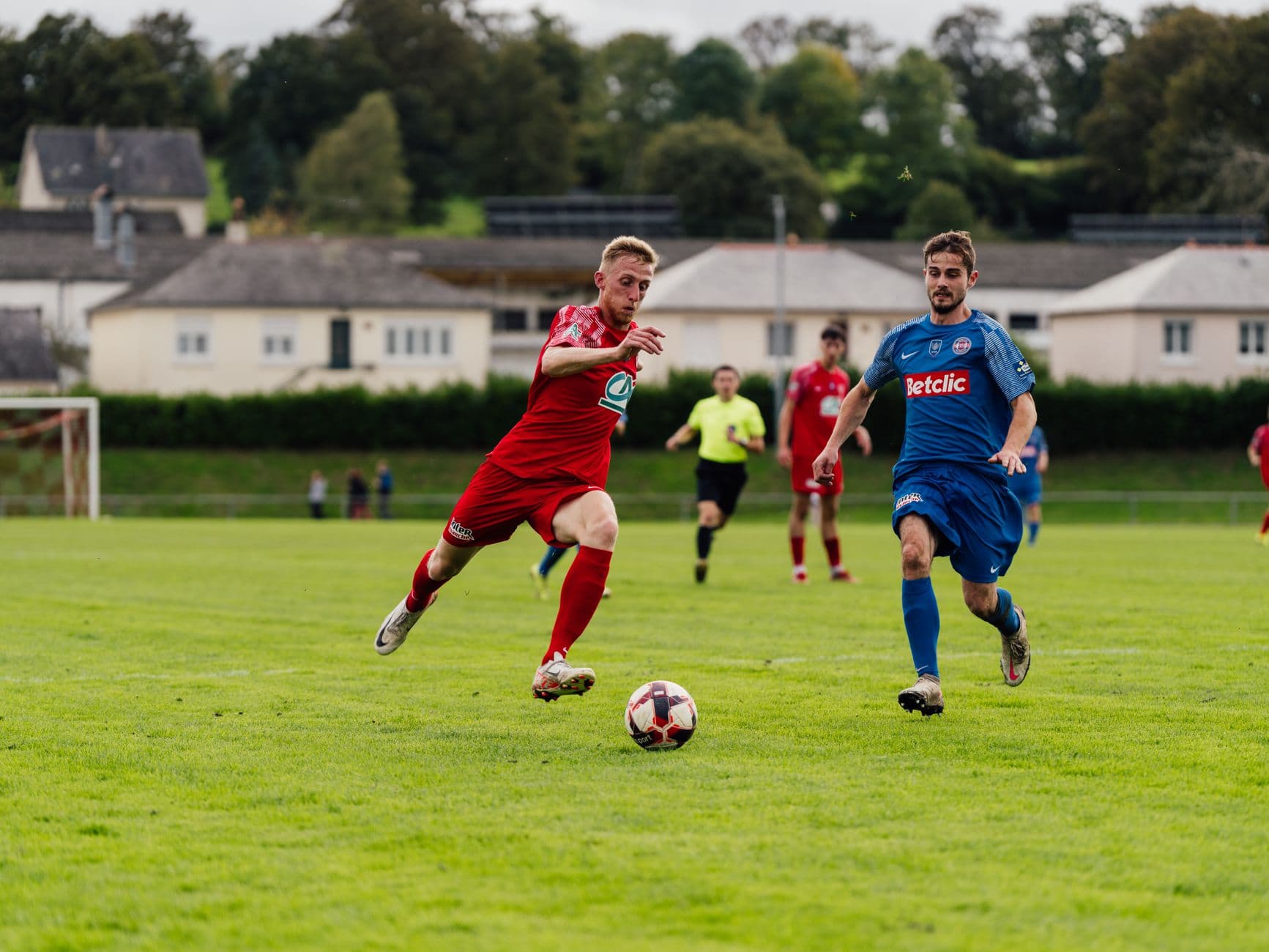
Sport-specific
Physical Preparation for Association Football (Soccer)
soccer · all levels · speed, power, anaerobic capacity, endurance, strength
Updated
How this document is used
This is one of the 44 documents the phase.fitness generator reads before writing a phase. It receives the principles below as context, and the numbers in it become the bands a generated program has to respect. The references at the end are stripped from the prompt — the model is not allowed to cite studies — and kept here, for you to check.
Association football is an intermittent sport played over roughly ninety minutes, in which an outfield player covers something in the order of 9–12 km, the large majority of it walking and jogging, punctuated by a few hundred short accelerations and several dozen genuinely high-speed efforts. The match is decided in those few seconds, but the ability to keep producing them in the last twenty minutes is what separates levels.
The physical programme therefore has an unusual shape: a large aerobic base that is almost never the limiting factor on match day, sitting underneath a small volume of very high-intensity work that is.
Note on terminology. This document covers association football — calcio, fútbol, soccer. American football is a different sport with a different energy profile and is covered separately.
Key Principles
1. The limiting quality is repeated sprint ability, not aerobic capacity
Well-trained footballers rarely lose matches because they run out of aerobic fitness. They lose the ability to repeat maximal efforts: the fifth sprint of a passage of play is slower than the first, and by the eightieth minute the first sprint is already slower than it was at kick-off.
Training that improves a treadmill test but not the decay curve across repeated efforts has improved the wrong thing. Repeated-sprint work — short maximal efforts with incomplete recovery — addresses this directly, and is the highest-specificity conditioning the sport has.
2. High-speed running exposure is protective, not just performance-enhancing
Hamstring injuries in football overwhelmingly occur during high-speed running, and the tissue is prepared for that stress only by experiencing it. An athlete who trains hard but never approaches maximum velocity arrives at a match with tissue that has not seen match speeds in weeks.
The practical consequence is that near-maximal sprinting belongs in the weekly plan as a scheduled item, in small doses, year-round — including in-season. Removing sprinting to "reduce load" frequently increases injury risk rather than reducing it.
3. Eccentric hamstring strength is the single best-supported intervention
Of everything in the football physical-preparation literature, eccentric hamstring work — the Nordic hamstring exercise and its progressions — has the strongest support as an injury-reduction measure. It is cheap, requires no equipment, and takes minutes.
It is also the item most frequently dropped, because it is uncomfortable and produces marked soreness when introduced too aggressively. Introducing it gradually, well before the season, is the difference between a habit and an abandoned experiment.
4. Change of direction is a braking problem
Footballers decelerate more often than they accelerate maximally. The tissue demand of stopping — high eccentric loads through the quadriceps and hip — is greater than that of starting, and deceleration ability is what allows a player to change direction sharply without losing balance.
Programming that trains acceleration and neglects deceleration produces players who are fast in a straight line and slow to turn.
5. In-season, the fixture list is the programme
With one or two matches per week plus team training, the strength coach is working in the gaps. Total weekly load is largely fixed by the fixture calendar; what remains controllable is distribution — which day carries intensity, which day carries volume, which day carries neither.
The common structure counts backwards and forwards from match day: the day after a match is recovery, the middle of the week carries the highest intensity, and the day before a match is short and sharp.
Guidelines & Recommendations
Weekly structure, in-season, one match per week
| Day | Emphasis |
|---|---|
| MD+1 | Recovery. Light movement, mobility. Optional upper-body work. |
| MD+2 | Highest gym load of the week. Strength, power, eccentric hamstring. |
| MD-3 | Highest running volume. Aerobic and repeated-sprint work. |
| MD-2 | Speed and change of direction, low volume, full recovery between efforts. |
| MD-1 | Activation. Short, sharp, nothing that creates soreness. |
| MD | Match. |
With two matches per week, the middle block compresses: the gym session shortens and holds intensity rather than volume, and running load comes almost entirely from the matches themselves.
Strength work
- Frequency: 2 sessions per week pre-season, 1–2 in-season.
- Emphasis: bilateral and unilateral lower-body strength, hip extension, and trunk.
- Loading: 3–5 sets of 3–6 reps at high intensity for the main lifts. Football players benefit from strength work that is heavy and low-volume, because the sport already supplies enormous volumes of low-intensity work.
- Non-negotiables: an eccentric hamstring exercise, a single-leg exercise, and a calf/Achilles exercise appear every week regardless of what else is cut.
Eccentric hamstring progression
Introduce over 4–6 weeks, starting well below what the athlete can tolerate acutely:
- Weeks 1–2: 1 set of 3–5 repetitions, once per week.
- Weeks 3–4: 2 sets of 4–6, once or twice per week.
- Weeks 5+: 2–3 sets of 6–8, maintained at 1 session per week in-season.
Soreness after the first exposure is expected and is not a reason to stop; soreness that persists beyond 72 hours means the progression moved too fast.
Jump work (plyometrics)
Jump training belongs in a footballer's gym week: it is the "power" in the MD+2 session.
- What it does: in adult male players, plyometric training improves jump height and 20-m sprint speed, but not strength, agility or sprint speed over other distances (van de Hoef et al., 2020, 17 randomised trials). The included trials were of low quality and heterogeneous, so the size of the effect is uncertain, not its direction. In young players (under 23) the pooled effects on vertical jump and linear sprint were moderate to large (Ramirez-Campillo et al., 2020, 33 studies, 1,499 players).
- How long: effects grow with duration. Programmes longer than 7 weeks and with more than 14 sessions improved 10-m sprint more than shorter ones (Ramirez-Campillo et al., 2020); across sports, programmes of more than 10 weeks and more than 20 sessions gave the largest gains in jump height (de Villarreal et al., 2009). A jump exercise is therefore a weekly item, not a peak-phase extra.
- Which jumps: a combination of jump types works better than one alone, and adding external
load gives no extra benefit (de Villarreal et al., 2009). Start with jumps onto a box or in
place, where the landing is controlled; depth jumps come later, after landing competence and a
strength base (see
training-team-sports-court, "Landing before jumping"). - Dose to start: low contacts at maximal intent and full recovery — e.g. box jump 3 × 6 with 90 s rest, or countermovement / jump squat 4 × 5 with 2 min rest. First in the session, while fresh.
- In-season: on the MD+2 gym day; nothing with ground contacts the day before a match.
Repeated-sprint conditioning
- Format: 5–8 efforts of 4–6 seconds, 20–25 seconds recovery, 2–4 sets with 3–4 minutes between sets.
- Placement: mid-week, on a day that is not adjacent to a match.
- Intent: every effort maximal. If times decay by more than roughly 10% across a set, the set is finished — beyond that point the athlete is training a slower pattern.
Speed and deceleration
- Maximal-velocity exposure: 2 short blocks per week, 4–6 efforts of 20–40 m at full effort with full recovery. This is a nervous-system item, not a conditioning item — rest is part of it.
- Deceleration: planned stops from submaximal approach speeds, progressing to sharper angles and higher entry speeds. Volume stays low; the tissue cost is high.
Aerobic base
Built primarily in pre-season and maintained by the sport itself thereafter. Extensive low-intensity running has a place in the off-season and in return-to-play, but adding aerobic volume to a player already training and playing rarely improves match performance and reliably increases fatigue.
Position-specific tendencies
- Full-backs and wide midfielders: highest high-speed running volumes. Sprint and hamstring work matters most here.
- Centre-backs: fewer but more intense accelerations, more jumping and physical contests. Strength and jumping emphasis.
- Central midfielders: highest total distance, lower peak speeds. Repeated-effort capacity.
- Forwards: highest number of maximal accelerations. Acceleration and deceleration emphasis.
- Goalkeepers: short explosive efforts, lateral movement, landing mechanics. A different programme, closer to a court sport than to the rest of the team.
Off-season and pre-season
- Off-season (2–4 weeks): genuine rest, then general strength. Detraining of high-speed running is the risk to manage — reintroduce sprinting before the first team session, not after.
- Pre-season (4–8 weeks): aerobic base and strength front-loaded, high-speed running introduced early and progressed gradually, repeated-sprint work in the second half.
Key Takeaways
- Train the decay curve across repeated efforts, not just aerobic capacity.
- Sprint year-round. Removing high-speed running to reduce load increases hamstring risk.
- Eccentric hamstring work is the best-supported single intervention. Introduce it slowly and never drop it.
- Deceleration is the neglected half of change of direction, and the more damaging half.
- In-season, distribution matters more than volume: the fixture list sets the total.
- Position changes the emphasis substantially — full-backs and forwards are not the same athlete.
References
- Verified against the published record, with DOIs so any number here can be
- checked rather than trusted. This document previously carried no sources at all.
- **Suchomel, T. J., Nimphius, S., & Stone, M. H. (2016).** The Importance of
- Muscular Strength in Athletic Performance. *Sports Medicine*, 46(10),
- 1419-1449. DOI: [10.1007/s40279-016-0486-0](https://doi.org/10.1007/s40279-016-0486-0) · PMID 26838985
- — The source for treating maximal strength as the base under the sport-specific
- qualities rather than an optional extra. Greater strength improves jumping,
- sprinting and change of direction, and stronger athletes perform better at
- sport-specific tasks while carrying a lower injury risk.
- **van de Hoef, P. A., Brauers, J. J., van Smeden, M., Backx, F. J. G., & Brink, M. S. (2020).**
- The Effects of Lower-Extremity Plyometric Training on Soccer-Specific Outcomes in Adult Male
- Soccer Players: A Systematic Review and Meta-Analysis. *International Journal of Sports
- Physiology and Performance*, 15(1), 3-17.
- DOI: [10.1123/ijspp.2019-0565](https://doi.org/10.1123/ijspp.2019-0565)
- — Seventeen randomised trials: jump height, 20-m sprint and endurance improve; strength,
- agility and other sprint distances do not. Low-quality, heterogeneous evidence.
- **Ramirez-Campillo, R., Castillo, D., Raya-González, J., Moran, J., de Villarreal, E. S., &
- Lloyd, R. S. (2020).** Effects of Plyometric Jump Training on Jump and Sprint Performance in
- Young Male Soccer Players: A Systematic Review and Meta-analysis. *Sports Medicine*, 50(12),
- 2125-2143. DOI: [10.1007/s40279-020-01337-1](https://doi.org/10.1007/s40279-020-01337-1)
- — 33 studies, 1,499 players under 23: vertical jump and linear sprint improve (ES 0.60-0.98);
- more than 7 weeks and more than 14 sessions improve 10-m sprint more.
- **de Villarreal, E. S., Kellis, E., Kraemer, W. J., & Izquierdo, M. (2009).** Determining
- variables of plyometric training for improving vertical jump height performance: a
- meta-analysis. *Journal of Strength and Conditioning Research*, 23(2), 495-506.
- DOI: [10.1519/JSC.0b013e318196b7c6](https://doi.org/10.1519/JSC.0b013e318196b7c6)
- — 56 studies: more than 10 weeks and 20 sessions give the largest gains; combine jump types;
- added load gives no extra benefit.
- **van Dyk, N., Behan, F. P., & Whiteley, R. (2019).** Including the Nordic
- hamstring exercise in injury prevention programmes halves the rate of hamstring
- injuries: a systematic review and meta-analysis of 8459 athletes. *British
- Journal of Sports Medicine*, 53(21), 1362-1370.
- DOI: [10.1136/bjsports-2018-100045](https://doi.org/10.1136/bjsports-2018-100045)
- — Risk ratio 0.49 in favour of programmes including the exercise. **Note what
- it does and does not show:** the evidence is for *hamstring* injuries. Reducing
- ACL injury is a different intervention — neuromuscular and landing-mechanics
- programmes — and attributing that outcome to this exercise overstates it. This
- document previously made exactly that mistake.