Calisthenics skills
Handstand push-up program: pike to freestanding
A handstand push-up is an overhead press with your bodyweight and a balance problem on top. phase.fitness splits the two: seven pressing steps from pike to freestanding, and a 30-second handstand as the gate to the last of them.
Updated
- Level
- Intermediate
- Length
- 8–20 weeks
- Days per week
- 2–3
- Modalities
- Calisthenics
- Equipment
- A wall, a floor, a box or a bench for the early steps; parallettes optional
- Sessions go to
- The phase.fitness built-in player
The short answer
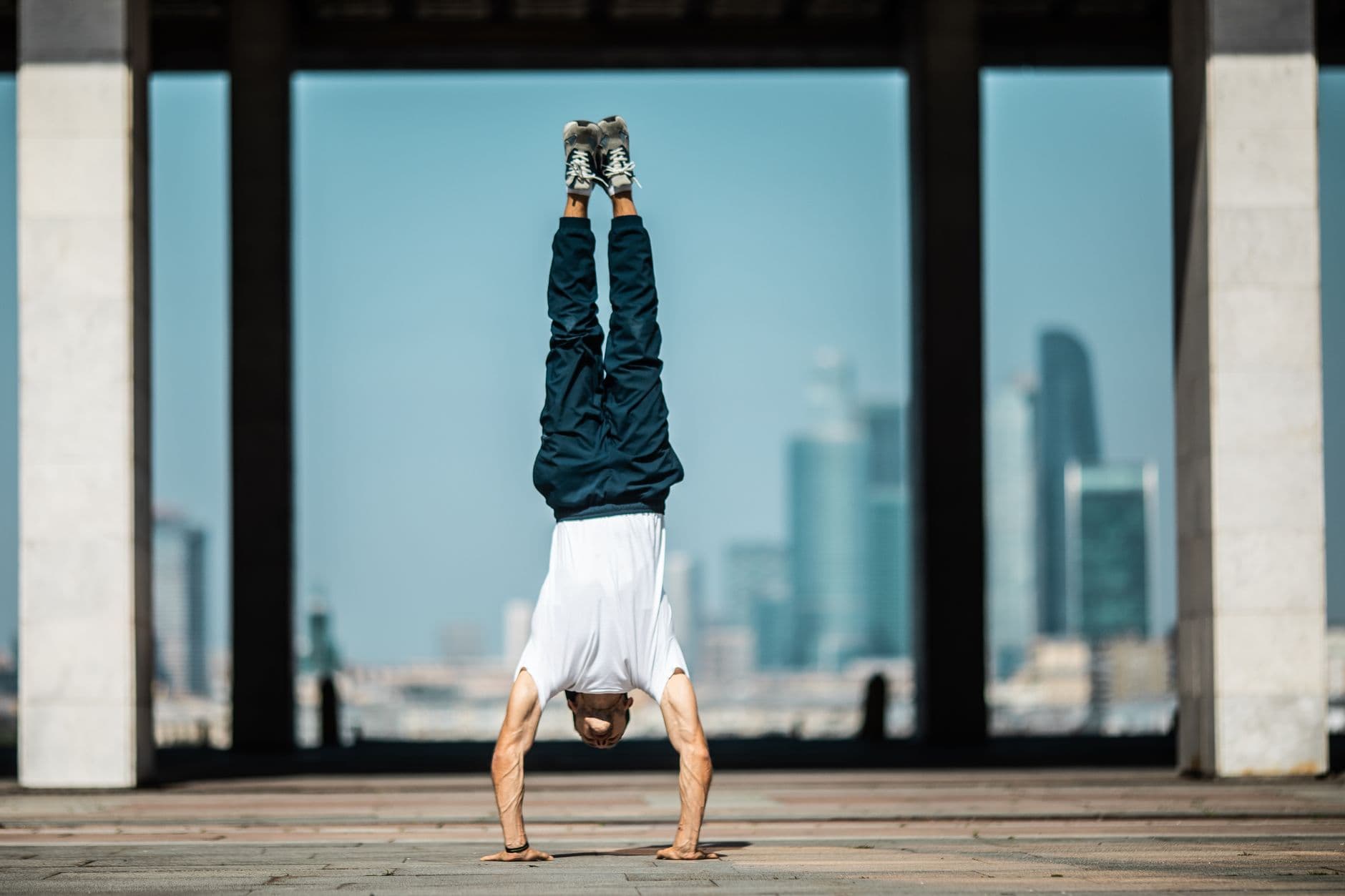
The phase.fitness handstand push-up program follows its catalogue: pike headstand push-ups and box headstand push-ups at 3–5 sets of 5–12, wall headstand push-up eccentrics at 3–5 × 3–6 with a 5–10 second lowering, wall headstand push-ups and wall handstand push-ups at 3–5 × 3–8, then freestanding headstand and handstand push-ups at 3–5 × 3–8 once the catalogue's prerequisites are met — a 30-second freestanding handstand and 5+ wall handstand push-ups. The assessment places you on the first step you cannot yet do; sessions run in the phase.fitness player and cost no AI credits.
Eccentrics first, then the press
The catalogue phase.fitness reads puts an eccentric step in the middle of this progression for a reason the strength-basics document explains: lowering under control at 5–10 seconds builds the strength through the range before the concentric exists, the same way muscle-up negatives teach the transition. Pike and box variants load a fraction of bodyweight; the wall takes the balance away so the press can be trained at 3–5 sets of 3–8, the strength dose the skill-sports document gives for maximal relative strength.
The freestanding versions are gated by the handstand program, not by pressing strength: a 30-second freestanding hold and five wall handstand push-ups are the prerequisites in the catalogue, and the program checks both before it prescribes the step.
What are pike push-ups good for?
They are the first step of the phase.fitness handstand push-up progression: the overhead pressing pattern at a fraction of bodyweight, at 3–5 sets of 5–12, together with box headstand push-ups. They build the press before the balance, which is why they come before anything against the wall.
How do eccentrics help with handstand push-ups?
They give you strength through the whole range before you can press through it. phase.fitness prescribes wall headstand push-up eccentrics at 3–5 sets of 3–6 with a five to ten second lowering, which is the step between the pike work and pressing back up under your own power.
What phase.fitness builds
A program is a sequence of phases, each with a job. These are the phases phase.fitness writes for this case, with the bands the generator has to respect — transcribed from the document it reads, not invented for this page.
Pike and box
3–6
Wall eccentrics
3–4
Wall presses
4–8
Freestanding
ongoing
| Phase | Weeks | Job | Band |
|---|---|---|---|
| Pike and box | 3–6 | Overhead pressing pattern at partial bodyweight | Pike headstand push-ups 3–5 × 5–12; box headstand push-ups 3–5 × 5–12 |
| Wall eccentrics | 3–4 | Strength through the range | Wall headstand push-up eccentrics 3–5 × 3–6, 5–10 s lowering |
| Wall presses | 4–8 | The full press against the wall | Wall headstand push-ups 3–5 × 3–8; wall handstand push-ups 3–5 × 3–8; standard: 5+ clean reps |
| Freestanding | ongoing | Balance and press together | Freestanding headstand push-ups, then handstand push-ups 3–5 × 3–8; requires a 30 s freestanding handstand |
A sample week
One week from the first phase, as it would sit on the calendar. Your own week follows the days you say you have — 2–3 here — and the equipment you list.
- KCalisthenics
- Rest
| Day | Modality | Session |
|---|---|---|
| Mon | K | HSPU step 4 × 5, wall handstand holds 3 × 30 s, ring or bench dips 3 × 8 |
| Tue | Rest | — |
| Wed | Rest | Lifting or running day, if the program has one |
| Thu | K | Eccentrics 4 × 4 at 8 s, pike push-ups 3 × 10, scapular work, external rotation |
| Fri | Rest | — |
| Sat | K | HSPU step 4 × 5, freestanding handstand practice, hollow holds |
| Sun | Rest | — |
S = strength · C = cardio · K = calisthenics. The order is the point: hard days are kept apart and the long session gets the clean slot.
How it adapts when a phase ends
Reps and RPE per set are logged in the phase.fitness player. When a phase ends, the current step is advanced only when the log shows the standard — clean reps at the prescribed count — and the freestanding steps are unlocked only when the handstand log shows the 30-second hold. A step that stalled stays, and the plan names the missing standard.
Where the sessions go
phase.fitness plans; you train in the app or on the watch you already use, and the completed session comes back. For this program:
What phase.fitness does not do here
The steps run in the phase.fitness player and are not pushed to Hevy, Liftosaur or a watch. Neck and wrist tolerance are part of the progression; pain that persists past a session is a reason to hold the step, not push through it.
The evidence
The documents this page is built from
These are the knowledge-base documents the phase.fitness generator reads for this case. The phases, bands and weekly numbers above are transcribed from them.
- Relative Strength and Neuromuscular Control for Skill and Aesthetic Sports — updated 2026-02-21, gymnastics
- Strength Training Basics — updated 2025-01-07
Read more in the knowledge base
Frequently asked questions
What are the handstand push-up steps?
Pike headstand push-ups, box headstand push-ups, wall eccentrics with a 5–10 second lowering, wall headstand push-ups, wall handstand push-ups, freestanding headstand push-ups and freestanding handstand push-ups — seven steps at 3–5 sets of 3–12 in the phase.fitness catalogue.
Do I need a handstand first?
Not for the wall steps in the phase.fitness progression. For the freestanding handstand push-up the catalogue requires a 30-second freestanding handstand and five wall handstand push-ups, and the program checks both before prescribing it.
How many sessions a week?
phase.fitness plans two or three, with the pressing work first and 2–3 minutes of rest between sets. It fits alongside strength or cardio days in the same program.
The only app that plans strength, cardio and calisthenics together
This page is the calisthenics day: the handstand push-up is vertical pressing at bodyweight, programmed with steps and eccentrics like any strength progression, and it belongs in the same week as your other training.
Right now, phase.fitness is the only training app that writes strength, cardio and calisthenics into one periodized program — same calendar, same phases, same recovery budget.
You choose the mix. A calisthenics-only plan, a cardio-only block, strength plus cardio, or all three: the phases, the end-of-phase analysis and the sync work the same way with one modality or three.
Why calisthenics is in the plan
Bodyweight skill work is strength training in a different shape. Straight-arm work, levers and handstands build scapular control, tendon capacity and relative strength that barbell and machine work leave untouched, and they transfer because they are closed-chain, whole-body patterns. Treated as a modality rather than a warm-up, they get sets, holds and progressions like a squat does.
No exercise catalogue on the market contains a tuck front lever, so those sessions run in the phase.fitness built-in player; strength goes to Hevy, Liftosaur or a Garmin watch, cardio to Garmin and Intervals.icu. How the skill work is programmed.
Free to start, no card. The first phase is yours to keep whatever you decide.