Sport-specific
Physiological Optimization for Long-Distance Performance
endurance · all levels · endurance, aerobic power, running economy, speed
Updated
How this document is used
This is one of the 44 documents the phase.fitness generator reads before writing a phase. It receives the principles below as context, and the numbers in it become the bands a generated program has to respect. The references at the end are stripped from the prompt — the model is not allowed to cite studies — and kept here, for you to check.
Endurance sports — running, cycling, triathlon, rowing, and cross-country skiing — are defined by the capacity to sustain moderate-to-high intensity work for prolonged durations. Performance is determined by three primary physiological variables: VO2 Max, lactate threshold, and movement economy. This document covers the evidence-based training principles that optimize these variables.
Physical Demands
Primary Demands
- VO2 Max (Maximal Oxygen Uptake): The ceiling of aerobic performance, and the single strongest predictor of endurance performance across mixed-ability populations. Elite male runners typically exceed 70–85 mL/kg/min; elite female runners 60–75 mL/kg/min.
- Lactate Threshold (LT): The exercise intensity at which blood lactate begins to accumulate exponentially. A higher LT relative to VO2 Max means the athlete can sustain a greater fraction of their aerobic ceiling for extended periods.
- Movement Economy: The oxygen cost of maintaining a given pace or power output. Two athletes with identical VO2 Max will differ in performance if one is more economical — requiring less oxygen per unit of speed.
Secondary Demands
- Fat Oxidation Capacity: In events lasting >90 minutes, the ability to oxidize fat at higher intensities spares glycogen and delays bonking.
- Thermoregulation: Heat dissipation efficiency affects performance in warm environments.
- Muscular Endurance and Durability: Maintaining force output and biomechanical integrity under fatigue, particularly in the later stages of marathons or Ironman events.
- Mental Resilience: Pacing, discomfort tolerance, and decision-making under fatigue play significant roles in competition.
Key Principles
1. The Polarized Training Model (80/20)
Analyses of elite endurance athletes across multiple sports show a consistent distribution: approximately 80% of training volume is performed at low intensity (below the first lactate threshold, LT1) and approximately 20% at high intensity (above the second lactate threshold, LT2). Very little training occurs in the moderate "threshold" zone between LT1 and LT2.
This pattern — termed "polarized training" — avoids the "Black Hole" of moderate intensity, where athletes train too hard to build aerobic base effectively but too easy to develop VO2 Max. Research comparing polarized vs. threshold-based models consistently favors the polarized approach for trained athletes.
2. Running Economy Responds to Strength Training
Heavy resistance training (1–6 reps) improves running economy by roughly 3–8%, through increased tendon stiffness, improved neuromuscular coordination, and greater force production at submaximal speeds — and does so without significant increases in body mass.
3. The Three-Variable Performance Model
Endurance performance is well predicted by the interaction of three variables:
Performance = VO2 Max × %VO2 Max at LT × Economy
This means training should address all three variables, with priority determined by the athlete's current limiters. Beginners typically benefit most from VO2 Max development; advanced athletes gain more from economy and LT improvements.
4. Specificity and Transfer
While cross-training offers recovery benefits and injury risk reduction, the principle of specificity dictates that the majority of training must be performed in the competition modality. A runner must primarily run; a cyclist must primarily cycle. Supplementary modalities (swimming for runners, running for cyclists) serve recovery and injury prevention roles.
Guidelines & Recommendations
Training Zone Framework
| Zone | Descriptor | Physiological Basis | % Max HR | RPE | Purpose |
|---|---|---|---|---|---|
| Z1 | Recovery | Below LT1 | 55–70% | 2–3 | Active recovery, fat oxidation |
| Z2 | Aerobic Base | Just below LT1 | 70–80% | 3–4 | Mitochondrial biogenesis, capillarization |
| Z3 | Tempo / Threshold | Between LT1–LT2 | 80–87% | 5–6 | Lactate clearance, threshold improvement |
| Z4 | VO2 Max Intervals | Above LT2 | 88–95% | 7–8 | VO2 Max development |
| Z5 | Anaerobic / Sprint | Near maximal | 95–100% | 9–10 | Neuromuscular power, anaerobic capacity |
Volume Guidelines by Sport
| Sport | Beginner | Intermediate | Advanced/Elite |
|---|---|---|---|
| Running | 25–40 km/week | 50–80 km/week | 100–200 km/week |
| Cycling | 5–8 hr/week | 10–15 hr/week | 15–30 hr/week |
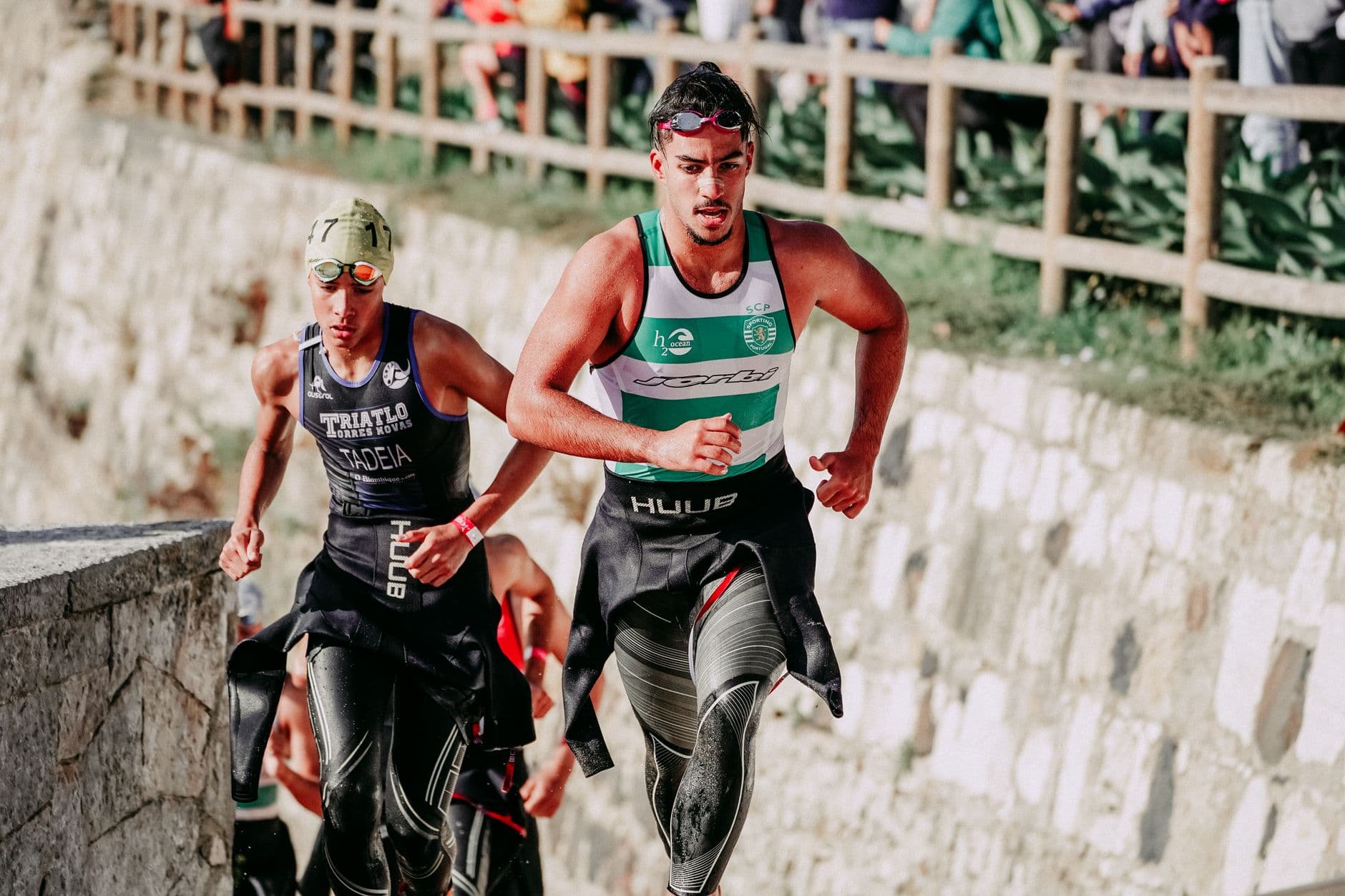
| Triathlon | 6–10 hr/week | 12–18 hr/week | 20–35 hr/week |
Key Workout Types
Long Run / Long Ride (Z1–Z2): The cornerstone of endurance training. Builds aerobic base, fat oxidation, and mental durability. Duration: 60–150 min for runners; 2–5 hours for cyclists. Keep intensity strictly in Z1–Z2.
Tempo Runs (Z3): 20–40 min sustained efforts at marathon pace or slightly faster. Improve lactate clearance and threshold pace. Limit to 1×/week for most athletes.
VO2 Max Intervals (Z4): 3–8 min intervals at 90–100% VO2 Max with equal or slightly shorter recovery. Example: 5 × 4 min at 3K–5K race pace, 3 min jog recovery. The most potent stimulus for VO2 Max improvement. 1–2×/week.
Strides / Short Sprints (Z5): 6–10 × 20–30 sec at near-maximal effort with full recovery. Maintain neuromuscular qualities and running/cycling mechanics. Low fatigue cost; can be appended to easy days.
Strength Training for Endurance Athletes
- Frequency: 2×/week (off-season), 1–2×/week (in-season).
- Focus: Heavy compound movements (squat, deadlift, step-up, calf raises) at 3–6 reps, 3–4 sets.
- Goal: Improve economy and injury resilience, not hypertrophy. Keep volume low and loads high.
- Plyometrics: Include 2–3 plyometric exercises (jump squats, bounding, drop jumps) to develop reactive strength and tendon stiffness. 3 × 6–8 reps.
- Timing: Perform strength training after easy runs or on separate days. Never before key quality sessions.
Practical Application
Sample Week (Intermediate Marathon Runner, 70 km/week)
| Day | Session | Duration/Distance | Zone |
|---|---|---|---|
| Mon | Easy Run + Strides | 10 km + 6 × 20 sec | Z1–Z2 |
| Tue | VO2 Max Intervals | 12 km total (5 × 4 min @ Z4, 3 min recovery) | Z4 |
| Wed | Easy Run + Strength | 8 km + 45 min gym | Z1 |
| Thu | Tempo Run | 14 km (including 30 min @ Z3) | Z3 |
| Fri | Rest or Easy Jog | 0–5 km | Z1 |
| Sat | Long Run | 22 km | Z1–Z2 |
| Sun | Rest | — | — |
Distribution: ~80% Z1–Z2, ~10% Z3, ~10% Z4. Consistent with the polarized model.
Periodization Across a Season
Base Phase (12–16 weeks): High volume, low intensity. Build aerobic foundation. 90% Z1–Z2. Introduce strength training. Build Phase (8–12 weeks): Add VO2 Max intervals and tempo work. Volume stabilizes or increases slightly. Intensity distribution shifts to 80/20. Peak Phase (4–6 weeks): Race-specific sessions. Practice goal pace. Reduce volume by 10–15%. Maintain intensity. Taper (2–3 weeks): Reduce volume by 40–60%. Maintain 1–2 quality sessions at race pace. Full recovery before competition.
In-Season / Competition Phase
During a racing season with multiple events:
- Maintain base fitness with 2–3 easy runs per week.
- Include 1 quality session (tempo or intervals) between races.
- Allow 1 day easy per 10 km of racing distance before resuming quality training.
- Use races as training stimuli where appropriate (B-races, tune-up races).
Injury Prevention
- Overuse Injuries (Runner's Knee, Shin Splints, Achilles Tendinopathy): Progress weekly volume by no more than 10% per week. Include strength training to address muscular imbalances.
- IT Band Syndrome: Strengthen hip abductors (clamshells, side-lying hip abduction, single-leg deadlifts).
- Stress Fractures: Ensure adequate calcium/vitamin D intake, appropriate footwear, and avoid excessive mileage jumps.
- Cycling: Low Back Pain: Core stability work and proper bike fitting are essential. Include dead bugs, bird dogs, and anti-rotation exercises.
Common Mistakes / Pitfalls
- The "Black Hole" of Moderate Intensity: Training too hard on easy days and too easy on hard days. This blunts adaptation and increases injury/burnout risk. Use heart rate or pace to enforce zone discipline.
- Neglecting Easy Days: Easy runs should feel genuinely easy (conversational pace). Many athletes run these too fast, accumulating unnecessary fatigue.
- Skipping Strength Training: Endurance athletes frequently avoid the weight room, missing economy improvements in the order of 3–8% and the injury resilience that comes with them.
- Excessive Volume Too Soon: Rapid mileage increases cause overuse injuries. The 10% rule (maximum weekly volume increase) is a useful guardrail.
- Ignoring Nutrition and Fueling: Chronic under-fueling (Relative Energy Deficiency in Sport — RED-S) impairs adaptation, hormonal health, and bone density. Carbohydrate periodization supports training quality.
- Racing Too Often: Each race requires recovery time. Over-racing reduces training quality and leads to fatigue accumulation.
Key Takeaways
- Follow the Polarized Model: 80% of volume below LT1 (easy), 20% above LT2 (hard). Minimise moderate-intensity "grey zone" work.
- Target all three performance variables: VO2 Max (intervals), lactate threshold (tempo), and economy (strength training, strides).
- Heavy resistance training (1–6 reps) improves economy by roughly 3–8% without adding mass. Include 1–2 strength sessions per week.
- Periodize across the season: Base → Build → Peak → Taper. Respect the principle of progressive overload with adequate recovery.
- Enforce easy-day discipline. Easy runs must be easy. Use HR monitoring to prevent intensity creep.
- Progress volume conservatively (max 10%/week) and include recovery weeks every 3–4 weeks (reduce volume 20–30%).
- Nutrition is a performance lever. Adequate carbohydrate intake fuels quality training; protein (1.4–1.8 g/kg/day) supports repair and adaptation.
References
- Beattie, K., Kenny, I. C., Lyons, M., & Carson, B. P. (2014). The effect of strength training on performance in endurance athletes. *Sports Medicine*, 44(6), 845–865.
- Joyner, M. J., & Coyle, E. F. (2008). Endurance exercise performance: the physiology of champions. *The Journal of Physiology*, 586(1), 35–44.
- Seiler, S. (2010). What is best practice for training intensity and duration distribution in endurance athletes? *International Journal of Sports Physiology and Performance*, 5(3), 276–291.
- Stöggl, T. L., & Sperlich, B. (2014). Polarized training has greater impact on key endurance variables than threshold, high intensity, or high volume training. *Frontiers in Physiology*, 5, 33.
- Mountjoy, M., et al. (2018). IOC consensus statement on relative energy deficiency in sport (RED-S). *British Journal of Sports Medicine*, 52(11), 687–697.
Source note: Seiler (2010), Joyner & Coyle (2008), Beattie et al. (2014)
Programs built from this document
 CS5K and 10K training plan, with the lifting built in8–12 wk · 4–5 d/wk · all levels
 CSHalf marathon training plan that keeps you strong10–14 wk · 4–6 d/wk · all levels
 CSMarathon training plan with strength that survives the build14–18 wk · 5–6 d/wk · intermediate
 CSTrail and ultra training plan: vert, descents, eccentric legs12–20 wk · 5–6 d/wk · intermediate
 CSCycling training plan built on power zones and real strength12–20 wk · 5–6 d/wk · all levels
 CSTriathlon training plan: three sports and one strength day12–20 wk · 6 d/wk · intermediate
 CSRowing training program: erg, base and strength10–18 wk · 5–6 d/wk · all levels
 CSCross-country skiing training plan for the off-season12–24 wk · 5–6 d/wk · all levels
 SCKHyrox training plan: running, stations and strength in one week10–16 wk · 5–6 d/wk · intermediate
 CSRunning and lifting in the same week8–16 wk · 5–6 d/wk · all levels
 CSCycling and strength training program12–20 wk · 5–6 d/wk · all levels
 SCRucking training plan, with the strength work that holds it up8–12 wk · 4–5 d/wk · all levels
 SCKStrength, cardio and calisthenics: one periodized program8–16 wk · 5–6 d/wk · all levels