Sport performance
Tennis and padel strength and conditioning program
phase.fitness plans tennis and padel as the racket-sports document describes them: power generated at the hips and transmitted through rotation, a body that is unilateral and asymmetric, movement measured in metres, and a shoulder that needs range first and control second.
Updated
- Level
- All levels
- Length
- 8–12 + season weeks
- Days per week
- 2–3 gym + court
- Modalities
- StrengthCardio
- Equipment
- Dumbbells or a rack, a medicine ball, bands for the shoulder, a court
- Sessions go to
- Hevy, Garmin, Strava
The short answer
A racket-sports program in phase.fitness runs an off-season block (2–3 strength sessions a week: split and lateral squats, hip hinges, anti-rotation trunk work, pulling volume at twice the pushing, shoulder external rotation and scapular work 2–3 times a week at low load), a build with rotational power (medicine-ball throws 3–5 × 4–6 per side at maximal intent, lateral and multidirectional jumps, change of direction over 2–6 m from planned to reactive) and conditioning by sport — tennis 6–10 s work with 20–25 s rest in blocks of 8–12, padel 15–30 s with 30–45 s recovery — and an in-season block where match play is the conditioning and the gym holds strength with two or three main lifts, few sets and no soreness.
The shoulder is the last link, not the engine
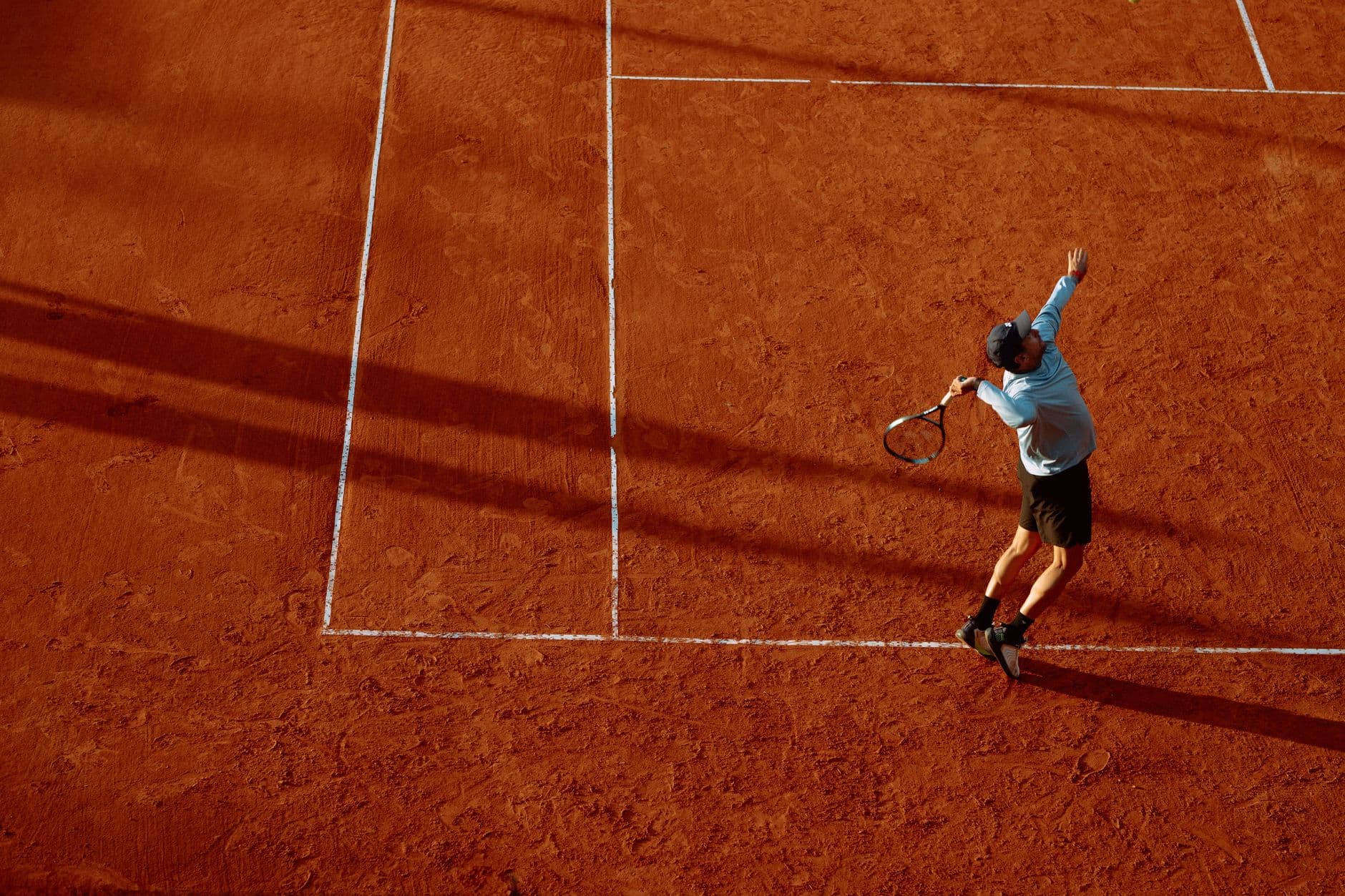
The racket-sports document phase.fitness reads corrects the instinct to train the shoulder as a prime mover: power is generated at the hips and transmitted through rotation, and the shoulder is where it arrives. So the strength work is lateral and unilateral — split squats, lateral squats, hinges — with anti-rotation as the primary trunk category, and the upper body pulls twice as much as it pushes to offset the sport's overhead, forward-dominant loading. Shoulder maintenance — external rotation, scapular work — is 2–3 times a week at low load, and it is the one item that survives every cut.
Conditioning by running is the error the document names: the sport is played in six metres, in four directions. Tennis points are 6–10 seconds with 20–25 of rest; padel rallies run 15–30 seconds with 30–45 of recovery. The phase.fitness conditioning engine prescribes repeated-sprint work in those ratios, and change-of-direction drills over 2–6 metres that progress from planned to reactive, because the sport never announces the next direction.
How do you train change of direction for tennis?
Over short distances, and in that order. phase.fitness builds change of direction from two to six metres, starting planned and becoming reactive as the block goes on, with lateral squats, lateral bounds and multidirectional jumps behind it. The distances match the court: almost nothing in a rally is a long run.
Is training for padel different from training for tennis?
The conditioning is. phase.fitness writes tennis efforts as 6–10 seconds of work with 20–25 seconds of rest in blocks of 8–12, and padel as 15–30 seconds with 30–45 seconds of recovery, because the rallies are longer. The strength and shoulder work is the same for both.
What phase.fitness builds
A program is a sequence of phases, each with a job. These are the phases phase.fitness writes for this case, with the bands the generator has to respect — transcribed from the document it reads, not invented for this page.
Off-season
4–6
Build
4–6
In-season
season
| Phase | Weeks | Job | Band |
|---|---|---|---|
| Off-season | 4–6 | Lateral and rotational strength; shoulder range and control | Strength 2–3×/week; split and lateral squats, hinges; Pallof and chops; pull:push 2:1; shoulder work 2–3×/week low load |
| Build | 4–6 | Rotational power and reactive change of direction | Med-ball throws 3–5 × 4–6/side, full recovery; lateral jumps; COD over 2–6 m planned → reactive; conditioning tennis 8–12 × (6–10 s / 20–25 s), padel 15–30 s / 30–45 s |
| In-season | season | Match play is the conditioning | Gym 1–2×/week: 2–3 main lifts, few sets, no soreness; conditioning dropped in competition weeks; shoulder block never cut |
A sample week
One week from the first phase, as it would sit on the calendar. Your own week follows the days you say you have — 2–3 gym + court here — and the equipment you list.
- SStrength
- CCardio
- Rest
| Day | Modality | Session |
|---|---|---|
| Mon | S | Split squat 4 × 5/leg, hip hinge 3 × 5, Pallof press, rows 2:1 over pressing, external rotation |
| Tue | Rest | Court |
| Wed | C | Repeated sprints: 3 blocks of 10 × (8 s / 22 s), 2–3 min between; reactive COD over 4 m |
| Thu | S | Lateral squat, med-ball rotational throws 4 × 5/side, lateral bounds, scapular work |
| Fri | Rest | Court |
| Sat | Rest | Match |
| Sun | Rest | — |
S = strength · C = cardio · K = calisthenics. The order is the point: hard days are kept apart and the long session gets the clean slot.
How it adapts when a phase ends
phase.fitness reads the gym sessions from Hevy, Liftosaur or the watch and the conditioning from Garmin or Intervals.icu; matches arrive as activities and count in the load. Garmin activities are read only if you allow it. Because the shoulder block is the one thing the document never cuts, a phase where it was skipped keeps it in the next one by dropping something else first. Competition weeks you flag remove conditioning entirely, as prescribed, and the plan is rewritten from the first free week.
Where the sessions go
phase.fitness plans; you train in the app or on the watch you already use, and the completed session comes back. For this program:
What phase.fitness does not do here
phase.fitness plans the gym and the conditioning around your court time; technique and match tactics are yours and your coach's. Padel and tennis reach a Garmin watch as generic cardio when pushed; the court sessions themselves are counted when your watch sends them back.
The evidence
The documents this page is built from
These are the knowledge-base documents the phase.fitness generator reads for this case. The phases, bands and weekly numbers above are transcribed from them.
- Rotational Power and Repeated Change of Direction for Racket Sports — updated 2026-08-23, racket sports
- Vertical Power and Anaerobic Capacity for Court-Based Team Sports — updated 2026-02-21, court sports
Frequently asked questions
Why is there so little running in a tennis program?
Because the racket-sports document phase.fitness reads says the sport is played in six metres in four directions, and conditioning by running trains the wrong quality. The plan uses repeated-sprint blocks in the sport's work-to-rest ratio — 6–10 s on, 20–25 s off for tennis; 15–30 s on, 30–45 s off for padel — and reactive change-of-direction drills.
How does the program protect the shoulder?
phase.fitness follows the racket-sports document — range first, then control: external rotation and scapular work 2–3 times a week at low load, pulling volume at twice the pushing, and the shoulder block kept in every phase including competition weeks — it is the one item the document never cuts.
What happens in a tournament week?
phase.fitness drops conditioning entirely, and the gym holds strength with two or three main lifts, few sets and nothing that creates soreness, as the in-season rule prescribes. Match play is itself the high-intensity conditioning.
The only app that plans strength, cardio and calisthenics together
For a tennis or padel player the calisthenics day is scapular control and anti-rotation trunk work — support holds, hollow and side holds — the shoulder maintenance and the bracing the serve loads a thousand times a week.
Right now, phase.fitness is the only training app that writes strength, cardio and calisthenics into one periodized program — same calendar, same phases, same recovery budget.
You choose the mix. A calisthenics-only plan, a cardio-only block, strength plus cardio, or all three: the phases, the end-of-phase analysis and the sync work the same way with one modality or three.
Why calisthenics is in the plan
Bodyweight skill work is strength training in a different shape. Straight-arm work, levers and handstands build scapular control, tendon capacity and relative strength that barbell and machine work leave untouched, and they transfer because they are closed-chain, whole-body patterns. Treated as a modality rather than a warm-up, they get sets, holds and progressions like a squat does.
No exercise catalogue on the market contains a tuck front lever, so those sessions run in the phase.fitness built-in player; strength goes to Hevy, Liftosaur or a Garmin watch, cardio to Garmin and Intervals.icu. How the skill work is programmed.
Free to start, no card. The first phase is yours to keep whatever you decide.